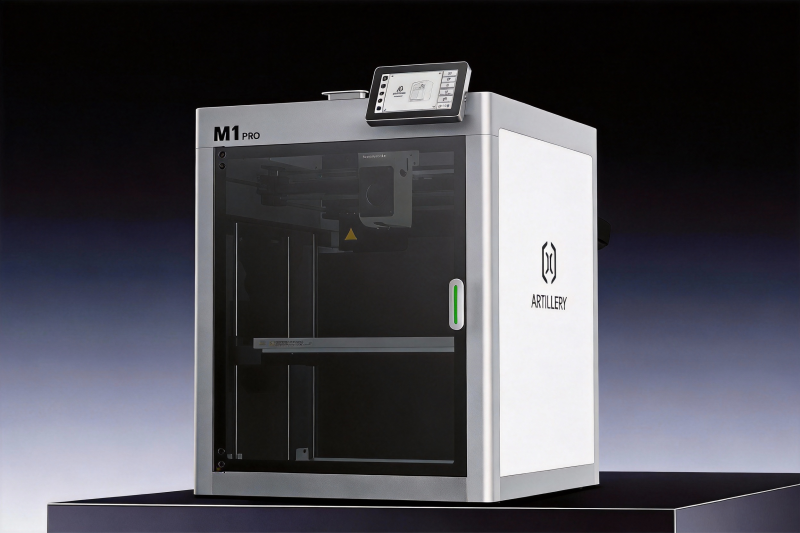
The Core Decision: Why Consider the Artillery M1 Pro S1?
The Artillery M1 Pro S1 targets a very specific segment of the consumer 3D printing market: users who want engineering-grade capabilities at a controlled budget, and who are willing to prioritize function over polish.
On paper, the specification set is unusually aggressive for its price range. The printer combines a CoreXY high-speed motion system, a fully enclosed structure, and an actively heated chamber, while still maintaining consumer-level accessibility.
Crucially, the S1 revision is not just a renamed bundle, but incorporates a series of structural and system-level optimizations that directly address early-generation concerns around feeding stability, thermal sensing, and long-duration reliability.
Core Hardware Specifications at a Glance
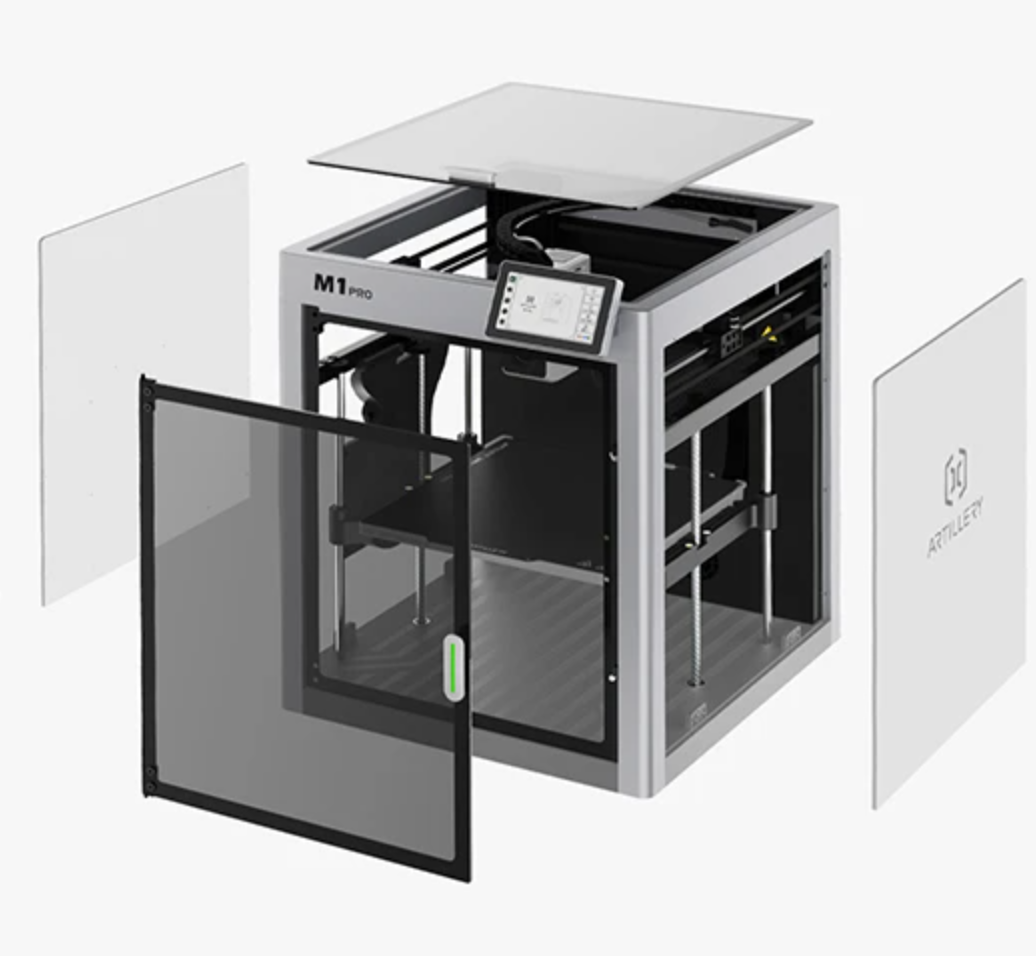
From a purely technical standpoint, the M1 Pro S1 positions itself as a compact but capable engineering printer:
- Build Volume: 260 × 260 × 260 mm³
- Motion System: CoreXY high-speed architecture
- Maximum Print Speed: Up to 600 mm/s (theoretical)
- Hotend Temperature: Up to 320 °C
- Print Accuracy: Up to 0.01 mm
- Enclosure: Fully enclosed structure with closed-loop cooling
- Automation: Automatic bed leveling + AI real-time monitoring
- Connectivity: Wi-Fi, SD card, touchscreen interface
This combination strongly indicates that the printer is designed for dimensional accuracy, thermal stability, and controlled high-speed motion, rather than purely decorative output.
What the “S1” Upgrade Actually Changes (Compared to Earlier M1 Units)
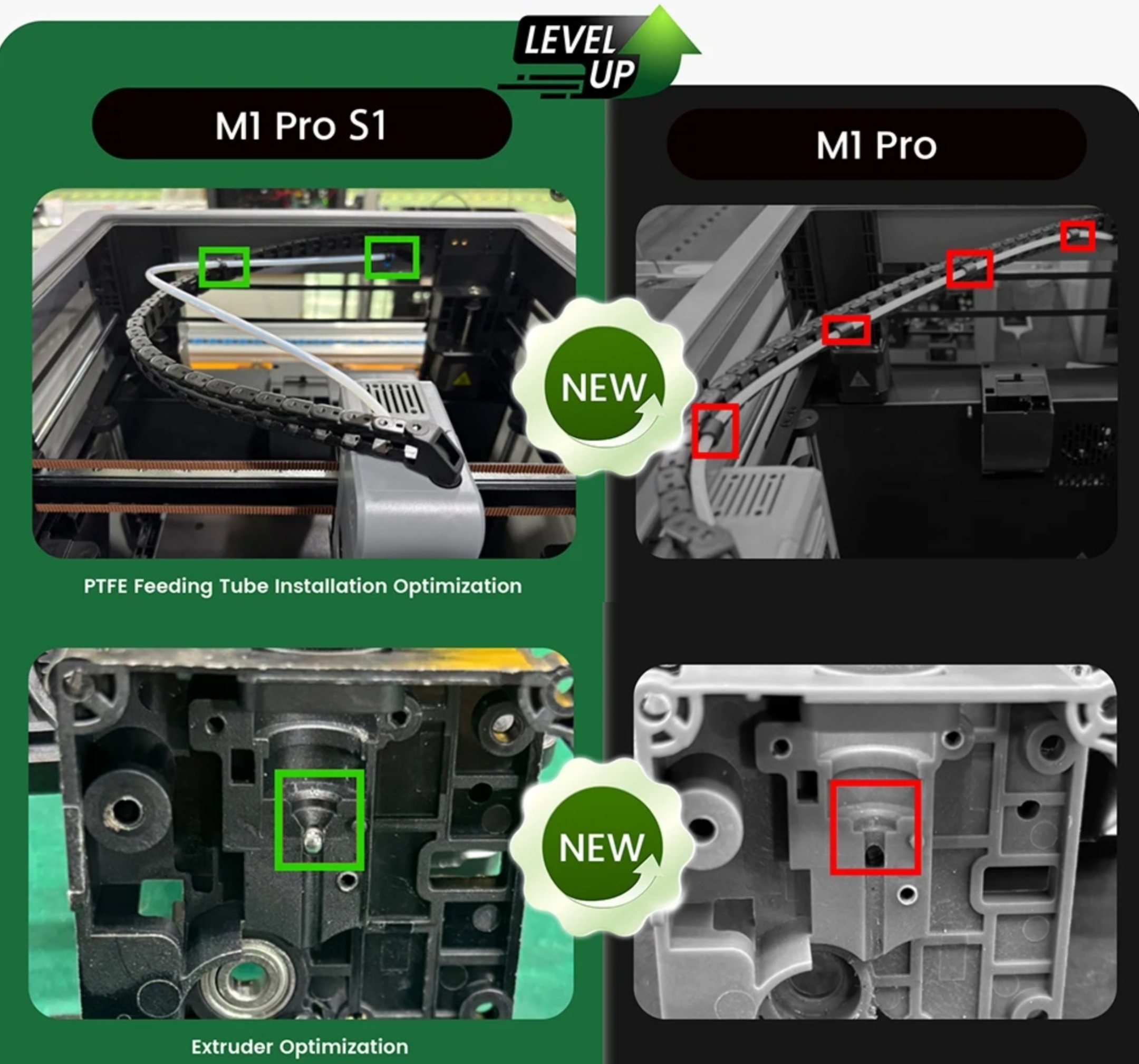
One of the most important clarifications for buyers is that the S1 is a hardware and system refinement, not merely a retail rebranding.
1. PTFE Filament Path Optimization
Earlier M1 units were sometimes criticized for filament routing that was sensitive to sharp bends during high-speed movement.
The S1 introduces:
- Optimized PTFE tube routing
- Improved fixation points along the filament path
- Reduced friction and bending stress
In practical terms, this improves feeding consistency, especially during rapid acceleration and retraction cycles.
Additionally, the filament ejector mechanism has been redesigned, making unloading smoother and reducing resistance during material changes—an often overlooked but meaningful quality-of-life improvement.
2. Chamber Temperature Sensor and Thermal Control Improvements
The S1 revision also improves how chamber temperature is measured and controlled:
- Sensor mounting position refined
- Improved fixation method
- Reduced sensitivity to airflow and environmental interference
As a result, chamber temperature feedback is more stable and more representative of actual internal conditions, improving consistency when printing ABS, ASA, or similar materials.
This directly strengthens the value of the 60 °C active heated chamber, ensuring that the temperature control system behaves predictably during long prints.
3. Extruder Structure Optimization
Key extruder components have been reworked to improve material intake stability, particularly under:
- High-speed motion
- Elevated chamber temperatures
- Long-duration prints
This optimization does not change the printer’s target audience, but it reduces the likelihood of feed-related interruptions, which is critical for functional printing.
4. Heated Bed, Magnetic Build Plate, and Surface Uniformity
The heated bed and magnetic platform have also been refined:
- Improved flatness
- Better surface adhesion
- More uniform heat distribution
These changes primarily benefit first-layer reliability, reducing edge lift and improving bottom-surface consistency—both essential for large ABS or ASA parts.
5. Mainboard Algorithm and System Software Upgrade
The M1 Pro S1 ships with an upgraded AP Board algorithm system (V2.00.10.00), delivering:
- More stable motion control
- Improved print logic coordination
- Better long-duration reliability
This is a meaningful point: hardware and software optimizations were developed together, which significantly improves consistency compared to earlier-generation behavior.
Speed, Precision, and Real-World Performance
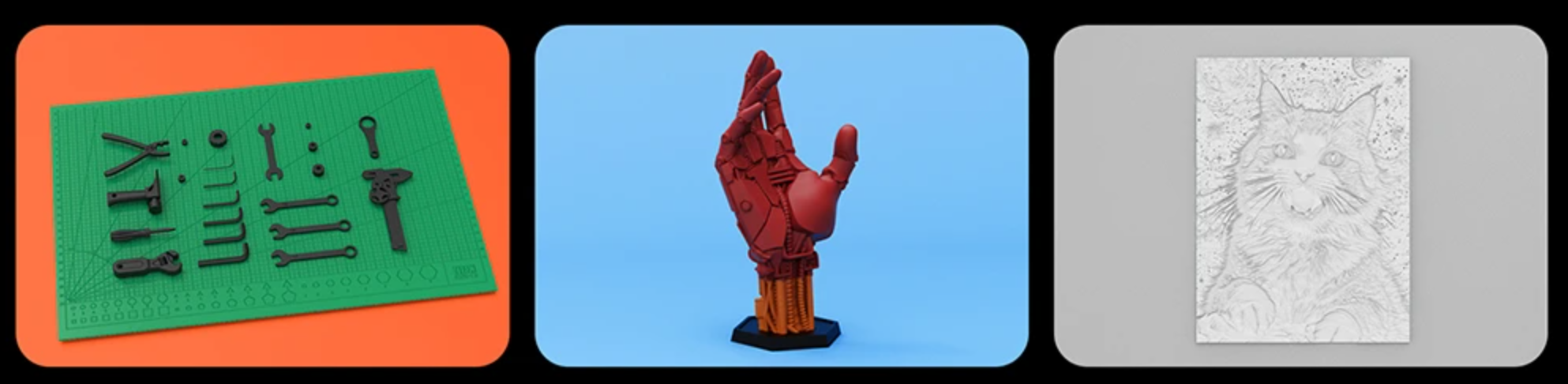
While the printer advertises speeds up to 600 mm/s, experienced users understand that maximum speed figures reflect kinematic potential, not guaranteed quality output.
In practice:
- Structural and functional parts are best printed at moderated speeds
- The CoreXY system provides strong mechanical rigidity
- Fine layer control supports precision printing down to 0.01 mm
The result is a printer that rewards tuning and calibration rather than blind reliance on factory presets.
Enclosure Design and Material Compatibility
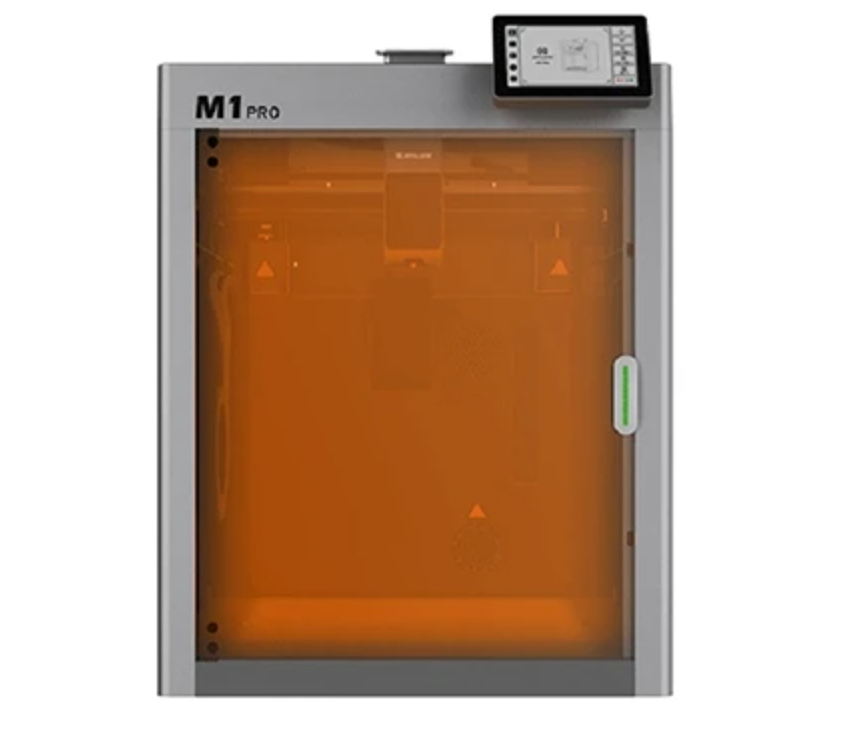
The fully enclosed structure, combined with closed-loop cooling and active chamber heating, is the defining feature of the M1 Pro S1.
This design significantly improves success rates with:
- ABS
- ASA
- Other warp-prone engineering materials
For users whose workflow depends on these materials, the enclosure system alone differentiates the M1 Pro S1 from many similarly priced competitors.
Connectivity, Monitoring, and Daily Usability
From an interaction standpoint, the printer supports:
- Touchscreen operation
- Wi-Fi printing
- SD card workflows
The addition of AI real-time monitoring enhances print supervision, particularly during long runs, although it should be viewed as an assistive feature rather than a replacement for proper setup and calibration.
Who Should Buy the Artillery M1 Pro S1?
Recommended For
- Users printing functional or mechanical parts
- Makers needing ABS / ASA capability on a controlled budget
- Intermediate users comfortable with calibration and tuning
Not Recommended For
- First-time 3D printer owners
- Users focused exclusively on PLA decorative models
- Buyers seeking an appliance-style, zero-intervention experience
Final Verdict
The Artillery M1 Pro S1 is best evaluated as a deliberately engineered upgrade, not merely a low-cost alternative.
By addressing filament routing, thermal sensing, extrusion stability, bed uniformity, and control algorithms, the S1 revision significantly improves reliability over earlier iterations—especially for long, enclosed, high-temperature prints.
For the right user, it offers one of the strongest engineering-focused value propositions in the consumer 3D printer market today.
For users outside that profile, simpler and more appliance-oriented machines remain the better choice.
