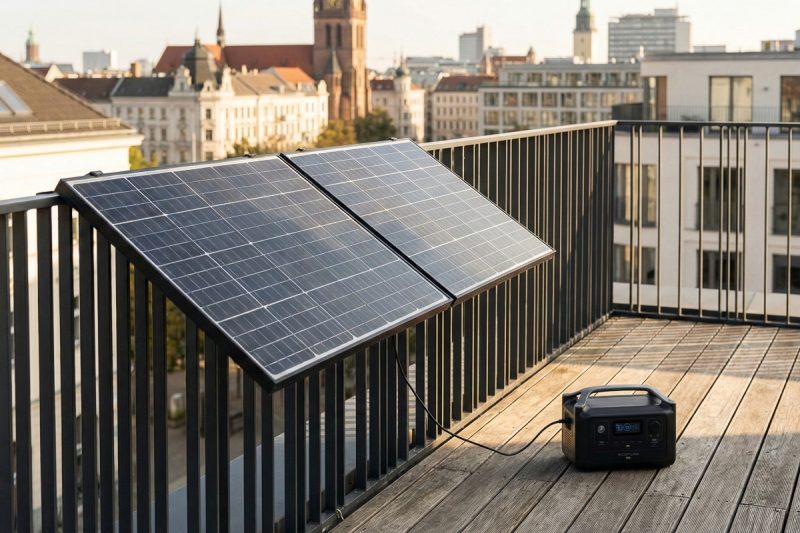
The idea behind a balcony solar portable power station setup sounds almost perfect: generate electricity from your apartment balcony, store excess solar energy in a battery, and reduce reliance on expensive grid power. For many European renters facing rising electricity costs, this hybrid micro-solar solution appears to promise both energy independence and long-term savings.
But does the math actually support the marketing claims?
From a decentralized energy systems perspective, balcony solar panels are often financially sensible on their own. However, adding a portable power station dramatically changes the economic equation. This guide breaks down real ROI expectations using European electricity pricing, storage efficiency models, seasonal production data, and real-life usage scenarios.
The Three-Second Suitability Filter
Before investing €1,000 or more in battery storage, answer these three quick questions. If any answer is NO, a panel-only setup may offer better financial value.
1. Is your electricity price above €0.30/kWh?
Battery storage economics strongly depend on electricity tariffs. In countries such as Germany or Denmark, where average household electricity prices often exceed €0.35/kWh, storage can produce modest financial returns. In France or Spain, where regulated tariffs often stay closer to €0.20–€0.25/kWh, storage frequently becomes more expensive than grid electricity.
2. Is your home empty between 10:00 and 16:00?
Balcony solar panels produce peak output during midday. If you work from home, most generated electricity is consumed instantly, leaving little surplus energy available for storage.
3. Do you have an unshaded south- or west-facing balcony?
Battery storage only works when solar production exceeds consumption. Shaded or north-facing balconies rarely generate enough excess electricity to fill a battery.
Understanding the Real Economics: Levelized Cost of Storage (LCOS)
To evaluate whether storage reduces electricity bills, we must calculate the Levelized Cost of Storage (LCOS) — the lifetime cost of storing one kilowatt-hour of electricity.
The Simplified Formula
Cost per Stored kWh = Battery Cost (€) ÷ (Battery Capacity × Lifetime Cycles × Efficiency)
Most LiFePO4 batteries used in portable power stations typically provide:
- 2,500–4,000 charge cycles
- 80–90% round-trip efficiency
- 6–10 years operational lifespan
Example Calculation: 1kWh Battery
Assume a 1kWh expansion battery costs €800.
- Lifetime stored energy: 1 kWh × 3,000 cycles × 0.85 efficiency = 2,550 kWh
- Storage cost: €800 ÷ 2,550 kWh = €0.31 per kWh
How Electricity Pricing Changes ROI
Storage profitability depends heavily on which grid electricity you replace.
| Country | Average Household Price | Typical Peak Price | LCOS | Outcome |
|---|---|---|---|---|
| Germany | €0.35–0.40 | €0.40–0.50 | €0.31 | Small profit possible |
| France | €0.20–0.25 | €0.25–0.30 | €0.31 | Often negative ROI |
Important Insight: Storage becomes more financially attractive when replacing peak-hour electricity, not average tariffs. Users with dynamic or time-of-use pricing can significantly improve ROI.
Total Cost of Ownership (TCO) Comparison
| Setup | Panel Only System | Panel + Battery System |
|---|---|---|
| Typical Upfront Cost | €400–€700 | €1,200–€1,800 |
| Annual Electricity Savings | €120–€180 | €160–€230 |
| Estimated Payback Period | 3–5 years | 8–10 years |
| Backup Power Capability | No | Yes |
| Installation Complexity | Low | Moderate |
Balcony solar panels alone typically offer faster financial returns. Batteries extend payback periods but add resilience and energy autonomy.
Real-World Usage Scenarios
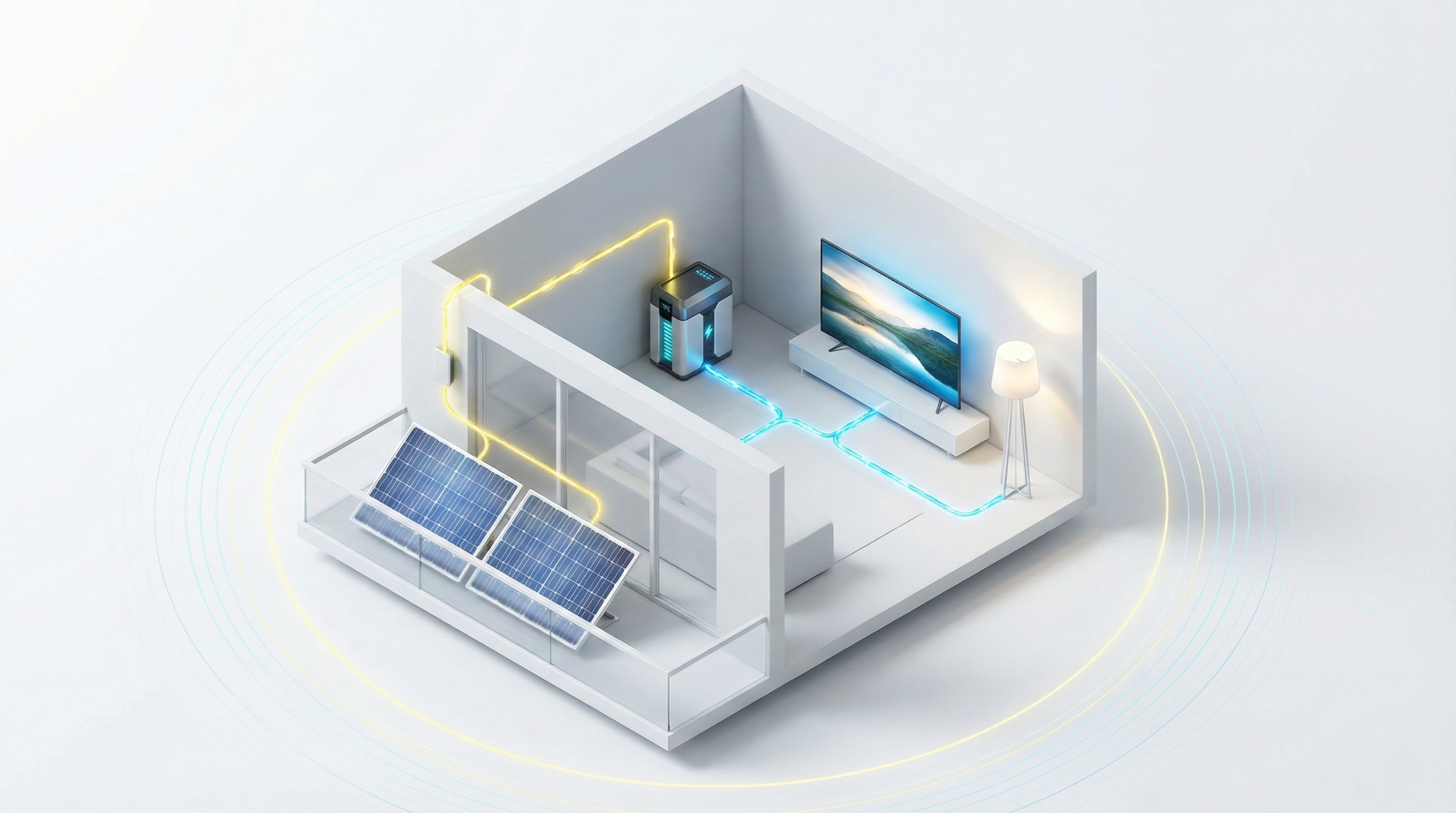
Scenario A: The 9-to-5 Commuter (Best Case)
- Leaves home during daylight hours
- Base consumption around 100W
- 800W balcony solar system produces midday surplus
Excess electricity charges the battery, which later powers evening activities like cooking or entertainment. This load shifting maximizes savings.
Scenario B: Remote Worker (Worst Case)
- Daytime electricity demand averages 300–400W
- Solar production is consumed instantly
- Minimal surplus energy reaches battery storage
In this scenario, battery utilization drops dramatically, resulting in poor ROI.
The “Winter Gap”: The Biggest ROI Risk
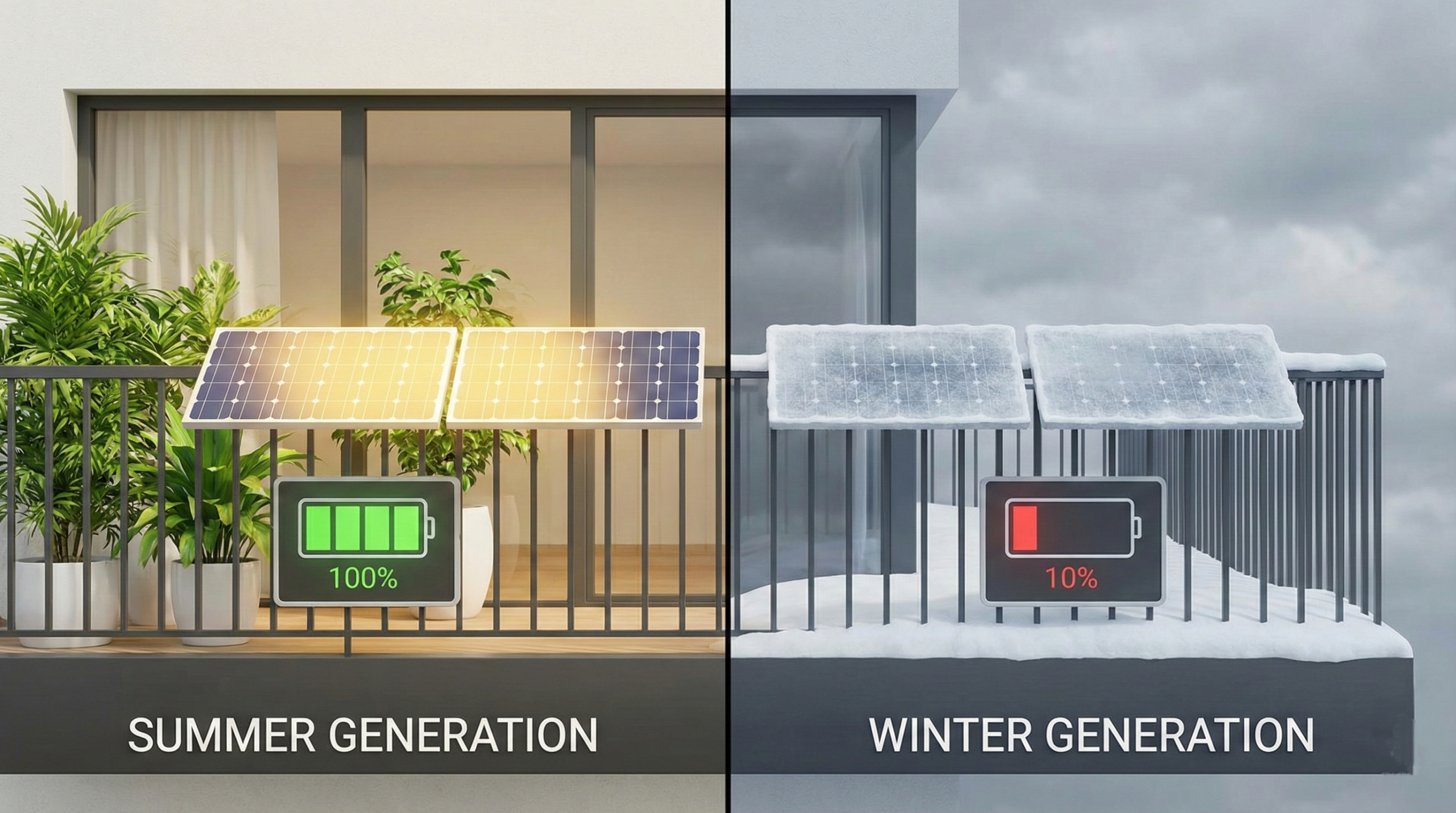
Most marketing ROI estimates assume daily battery cycling throughout the year. This is rarely realistic in Central Europe.
Typical seasonal production for an 800W balcony solar system:
| Season | Daily Solar Production |
|---|---|
| Summer | 3–4 kWh |
| Winter | 0.3–0.6 kWh |
Winter solar output often barely covers essential appliances, preventing battery charging. In practice, many European balcony solar systems achieve only 180–260 full storage cycles per year, significantly extending payback periods.
Practical Installation Limitations for Apartment Users
Cable Routing Challenges
Portable power stations often require thicker cables compared to panel-only setups. Renters may need to leave windows partially open or route cables through wall gaps.
Fan Noise Considerations
Many portable power stations generate approximately 40–45dB noise during charging or discharging, which can be noticeable in small apartments.
Cold Weather Restrictions
Lithium batteries should not be charged below 0°C. Storage units usually must remain indoors during the winter months.
Regulatory Considerations in Germany and France
Germany
- Balcony solar feed-in limit: 800W
- Mandatory registration in Marktstammdatenregister (MaStR)
- 0% VAT for solar and storage systems
- Regional storage subsidies are available in some cities
France
- Simplified registration via CACSI declaration
- Plug-and-play balcony solar systems are commonly used
- Dedicated reinforced sockets are recommended for continuous loads
When Does Balcony Solar + Battery Storage Make Sense?
Buy It If:
- Electricity costs exceed €0.35/kWh
- You are typically absent during solar production hours
- Your balcony receives strong sunlight
- You value backup power during outages
- Subsidies or tax incentives reduce upfront costs
Consider Panels Only If:
- Electricity costs remain below €0.25/kWh
- You work from home and consume solar energy instantly
- Your balcony receives limited sunlight
- Fast financial payback is your primary goal
The Most Overlooked Energy Optimization Strategy
Behavioral energy management often delivers better savings than storage technology. Running dishwashers, washing machines, and charging devices during midday solar production achieves nearly 100% energy efficiency without additional investment.
FAQ: Balcony Solar Storage for European Apartments
Is balcony solar legal for renters?
Yes, but registration and safety requirements vary by country. Germany and France both allow plug-and-play systems with proper registration.
Can a portable power station power an entire apartment?
Usually not. These systems primarily offset small appliances and evening peak consumption rather than providing full home energy independence.
Does balcony solar work during winter?
Yes, but production drops significantly. Most systems generate limited surplus energy between November and February.
How long does battery payback usually take?
Most balcony solar batteries achieve payback periods between 7 and 10 years, depending on electricity pricing and usage patterns.
Final Verdict
A balcony solar portable power station setup can reduce electricity bills under the right conditions, particularly in high-cost European electricity markets. However, while balcony solar panels alone often provide rapid financial returns, battery storage should be viewed as a hybrid investment combining modest savings, backup energy security, and lifestyle flexibility.
For many apartment users, the most financially efficient strategy is starting with solar panels and optimizing consumption patterns before expanding into storage.
