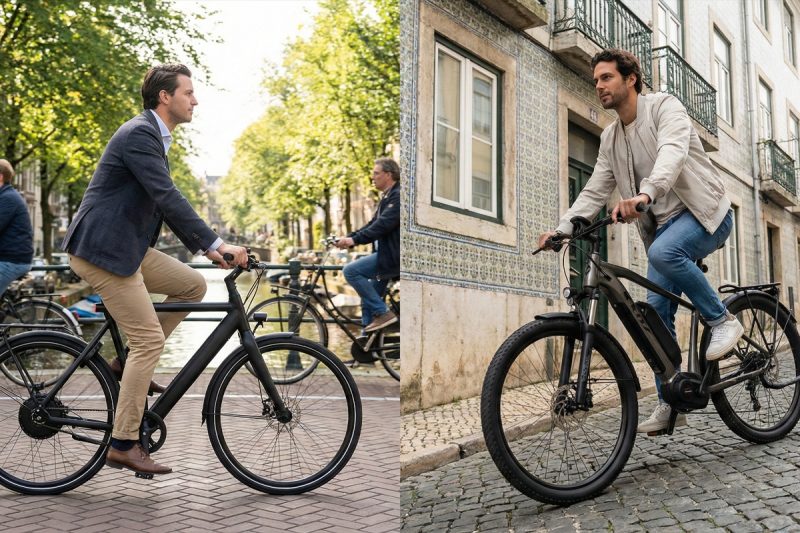
If you are shopping for your first electric bike in Europe, you have likely hit a confusing price wall. You see two bikes that look almost identical: both have 250W motors, both have similar batteries, and both are street-legal. Yet, one costs €1,200, and the other costs €1,700.
The difference usually comes down to one component: the motor location. The cheaper bike uses a hub motor (in the rear wheel), while the expensive one uses a mid-drive motor (between the pedals).
For many buyers, that €500 difference is the price of a second battery, a high-quality lock, and two years of maintenance combined. The industry marketing will tell you that you must have a mid-drive for hills. But is that actually true? Or are you about to pay a “performance tax” for engineering you don’t actually need?
This guide strips away the marketing jargon to help you self-diagnose your commute. By the end, you will know exactly which motor belongs on your streets—and whether you can safely keep that €500 in your pocket.
The Physics of Climbing: Why “250 Watts” Isn’t Always Equal
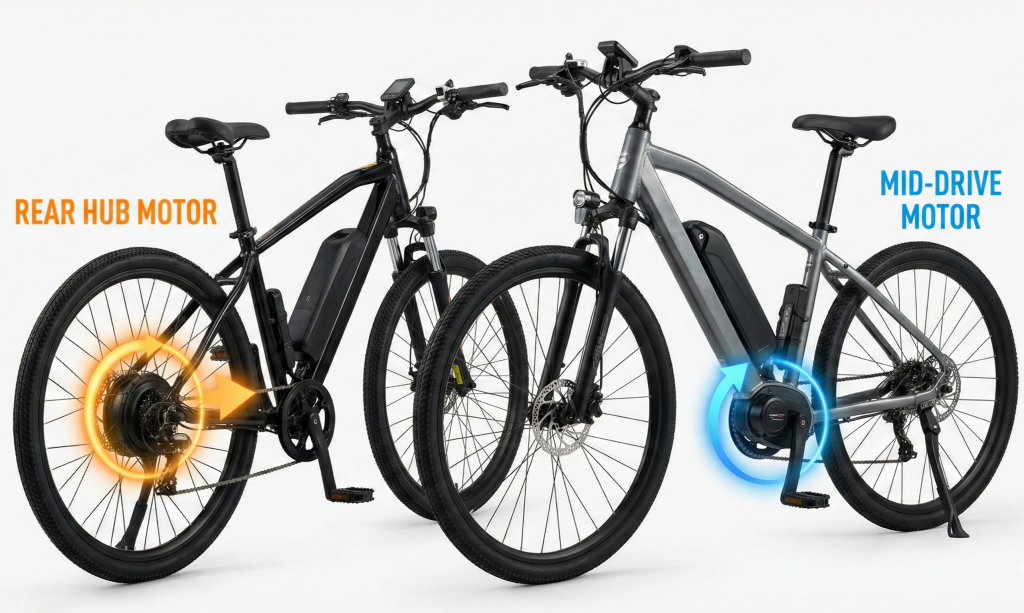
To understand the decision, you first need to understand why a 250W mid-drive feels different than a 250W hub motor on a steep incline.
In Europe, e-bike motors are legally limited to 250 watts of continuous power. However, the law does not limit torque (turning force) or how the motor delivers that power.
The Hub Motor: The “4th Gear” Problem
A hub motor pushes the wheel directly. It is simple, reliable, and affordable. However, it operates independently of your bike’s gears. Imagine driving a manual car but being stuck in 4th gear. On flat ground (highway), it’s efficient and smooth. But if you try to drive up a steep hill in 4th gear, the engine struggles, overheats, and loses power.
- Best for: Maintaining speed on flats and gentle rollers.
The Mid-Drive: The “Gearbox” Advantage
A mid-drive motor powers the chain, not the wheel. This means it benefits from your bike’s rear gears (the cassette), just like your legs do. When you shift into a low gear to climb a hill, the motor also shifts into that low gear. It can spin fast (efficiently) while the wheel turns slowly.
- Best for: High-torque climbing at low speeds.
The “Slope Test”: Diagnose Your Daily Reality
“Hilly” is a subjective term. A rider in Amsterdam thinks a canal bridge is a hill; a rider in Stuttgart faces 15% gradients daily. To make the right financial decision, you need to quantify your terrain.
Use an app like Komoot or Google Maps (Cycling Mode) to check the gradient of your daily route. Then, match it to these three zones:
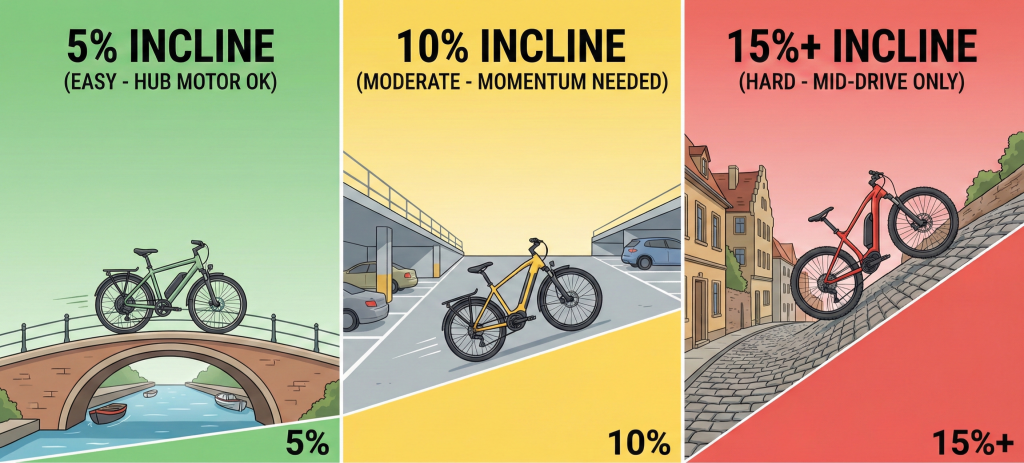
Zone 1: The “False Flat” (0% – 5% Gradient)
- Real World Examples: Railway underpasses, canal bridges, long gentle rises in suburban areas.
- The Verdict: Hub Motor Wins.
- A hub motor will fly up these inclines without breaking a sweat. In fact, because hub motors apply power directly to the wheel, they often feel faster and zippier in this zone than expensive mid-drives.
- Financial Advice: Spending extra for a mid-drive here is a waste of money.
Zone 2: The “Sweat Zone” (6% – 10% Gradient)
- Real World Examples: Parking garage ramps, standard hilly city streets (e.g., parts of Paris, Brussels, or Edinburgh).
- The Verdict: The “It Depends” Zone.
- A decent hub motor (40Nm+ torque) can handle this, provided you maintain momentum. If you can hit the hill at 20 km/h, the motor will carry you over.
- The Risk: If you are forced to stop halfway up (e.g., at a red light), a hub motor will struggle to get you moving again. You will have to stand up and pedal hard to help the bike.
- Financial Advice: If you are fit and don’t mind light exercise, a hub motor saves you €500. If you want a “sweat-free” guarantee, look at mid-drives.
Zone 3: The “Wall” (11% – 15%+ Gradient)
- Real World Examples: The steepest streets in Lisbon, Lausanne, Stuttgart, or Sheffield.
- The Verdict: Mid-Drive is Mandatory.
- On these slopes, a hub motor’s efficiency collapses. The motor turns electricity into heat rather than motion. You will likely stall, risking a “walk of shame” pushing your heavy e-bike.
- A mid-drive in 1st gear will climb this like a mountain goat, even if you are moving at a slow 6 km/h.
- Financial Advice: The €500 premium is not a luxury here; it is a functional requirement.
Decision Framework: Who Should Keep the €500?
You should buy the Hub Motor and save the money if:
- Your Commute is “Momentum-Friendly”: Your hills are short bursts (under 300 meters) where you can carry speed into the climb. Hub motors love momentum.
- You Are on a Strict Budget (<€1,500): In this price range, a high-quality hub motor (like Bafang) is far better than a cheap, low-quality mid-drive that uses plastic internal gears.
- You Want Low Maintenance: This is the hidden superpower of hub motors. Because the motor bypasses the chain, your chain and cassette last 3x longer. You can often go 5,000 km without replacing drivetrain parts.
- Pro Tip (The Secret Weapon): If you choose a hub motor, try to find one with a Torque Sensor rather than a Cadence Sensor. It makes the ride feel much smoother and more “natural,” similar to a mid-drive, without the high cost.
Decision Framework: Who MUST Spend the Extra €500?
You should buy the Mid-Drive if:
- You Have “Stop-and-Go” Hills: If your route has traffic lights or stop signs located on a steep incline, a hub motor will fail. Mid-drives offer explosive torque from a dead stop (Zero RPM).
- You Are a “Heavy Hauler”: If you weigh over 100kg, or if you carry heavy cargo (child seats, groceries), gravity is your enemy. Hub motors struggle with heavy loads on inclines because they cannot leverage gears.
- You Have Knee or Joint Issues: If you need the bike to do 80-90% of the work on a hill, only a mid-drive (specifically one with a Torque Sensor) can provide that level of assistance at low pedaling speeds.
- Range Anxiety is Real: On very hilly terrain, mid-drives are 15-20% more efficient. By spinning at optimal RPMs, they sip battery power while hub motors guzzle it trying to fight resistance.
The Hidden Costs: Maintenance & Longevity
The price tag is not the only cost. The “Total Cost of Ownership” (TCO) over 3 years looks very different for these two motor types.
| Feature | Hub Motor (Rear) | Mid-Drive (Center) |
|---|---|---|
| Purchase Price | Typically ~€500 cheaper | More expensive |
| Chain Wear | Low. Motor creates zero strain on the chain. | High. Motor power runs through the chain. |
| Chain Life | Expect 5,000+ km | Expect 1,500 – 2,500 km |
| Tire Changes | Difficult. Requires a wrench and cable disconnect. (Tip: Invest in puncture-resistant tires like Schwalbe Marathon to avoid this.) | Easy. Standard bicycle wheel removal (quick release). |
| 3-Year Drivetrain Cost | € (Low) | €€€ (High) |
The Reality Check: A mid-drive bike is more expensive to buy and more expensive to maintain. You are paying for performance. If you don’t use that performance (i.e., you ride on flat ground), you are paying a premium for faster chain wear.
Summary: The Final Verdict
Don’t let the sales brochure bully you. European cities vary wildly, and so should your choice of bike.
- Choose the Hub Motor if: You live in Berlin, London (mostly), Paris (mostly), or Amsterdam. You want a simple, reliable, low-maintenance machine for getting from A to B, and you don’t mind putting in a little effort on the occasional ramp.
- Choose the Mid-Drive if: You live in a “vertical” city like Zurich, Lisbon, or hilly parts of Bristol. You need a machine that guarantees you will arrive at work without sweat, regardless of the load you carry or the steepness of the street.
The “best” motor isn’t the most powerful one. It’s the one that matches your terrain without forcing you to pay for engineering you’ll never use.
Frequently Asked Questions
Can a 250W hub motor climb steep hills?
Yes, but with limits. A 250W hub motor can handle gradients up to 10-12% effectively if you maintain speed. However, if you stop on the hill, it may struggle to start again. For slopes over 15%, a mid-drive is strongly recommended.
Do mid-drive motors use less battery on hills?
Yes. Because mid-drives use the bike’s gears, they can keep the motor spinning at high efficiency (high RPM) even when the bike is moving slowly. Hub motors can lose 15-20% of their energy as heat when climbing steep hills at slow speeds.
Is a cheap mid-drive better than a good hub motor?
Not necessarily. A high-quality hub motor from a reputable brand (like Bafang) is often smoother, quieter, and more reliable than a generic, cheap mid-drive that may suffer from plastic gear failure or poor torque sensing.
