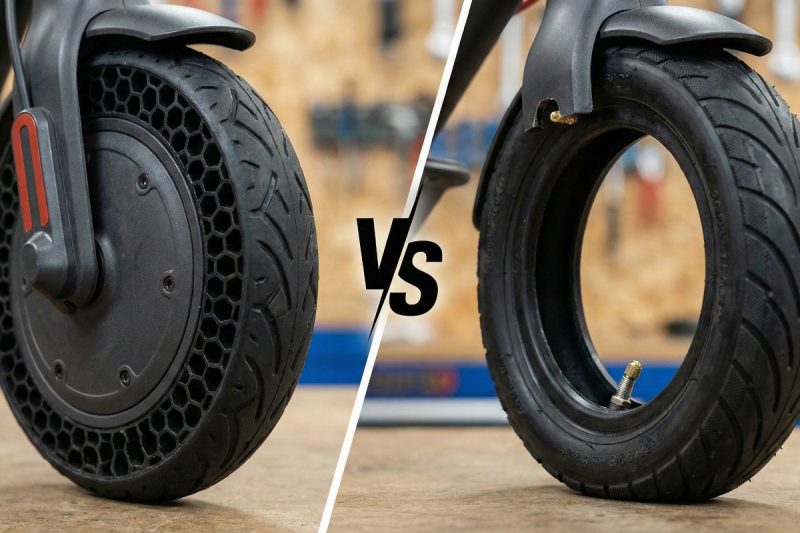
You are standing in the scooter shop—or staring at an online checkout page—faced with the classic rider’s dilemma. On one hand, you have pneumatic (air-filled) tires, offering a plush, grippy ride but carrying the constant, nagging threat of a flat tire. On the other hand, you have solid (airless) tires, promising total immunity to punctures but threatening to rattle your teeth on every cobblestone.
It isn’t just a choice between rubber types; it is a choice between two different anxieties. Do you prefer the mental anxiety of potentially being stranded with a flat, or the physical fatigue of constant vibration?
The “golden rule” of electric scooters is simple: Tires are your first line of suspension. If your scooter lacks heavy-duty springs, your tires are the only thing separating your skeleton from the road. Before you commit to the “no flat” lifestyle, you need to understand exactly what that trade-off feels like in the real world.
The Tactile Simulation: What the Ride Actually Feels Like
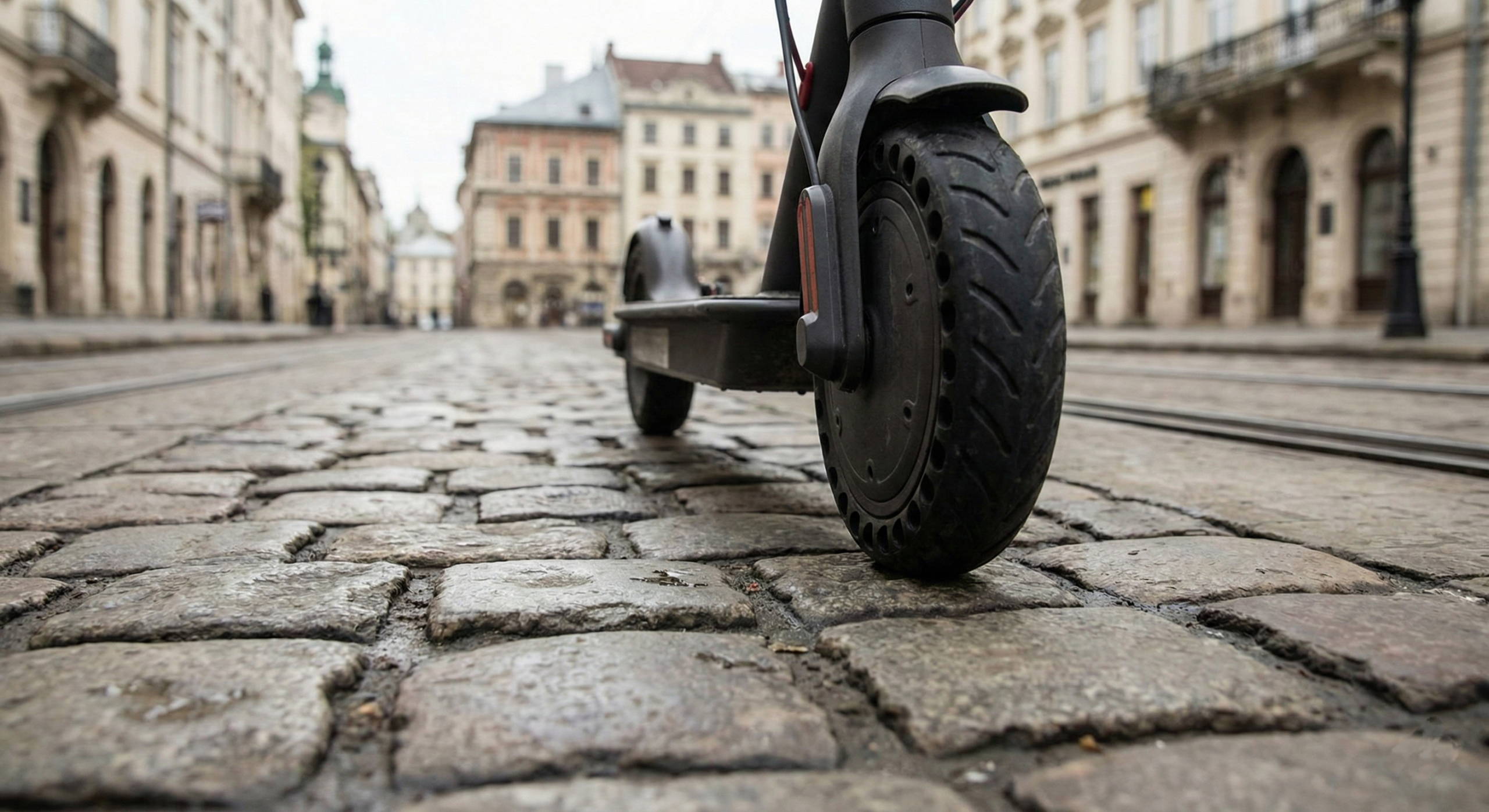
Specs don’t tell you how a ride feels at 7:00 AM on a Tuesday. To help you decide, let’s simulate the tactile difference between solid and pneumatic tires on common European urban terrain.
Simulation A: The “Old Town” Cobblestone Run
- Pneumatic Tires: As you hit the stones, you hear a dull, rhythmic thudding. The air inside the tires compresses, allowing the rubber to deform over the edges of the stones. You feel the surface change in your hands, but your vision remains clear. The ride is active but manageable.
- Solid Tires: The moment you leave the asphalt, the sensation is violent. The high-frequency vibration travels instantly up the stem to the handlebars. The noise level jumps from a hum to a loud clatter. Riders often experience “chatter,” where the vibration is so intense that it creates a blurring effect in their vision. On a solid-tire scooter without suspension, 100 meters of cobblestones feels like a jackhammer session.
Simulation B: Cracked Urban Asphalt & Frost Heaves
- Pneumatic Tires: The tires “float” over small cracks and frost heaves. The air cushion absorbs the sharp edges, meaning you don’t have to constantly scan the road for minor imperfections. You stay relaxed.
- Solid Tires: Every crack, twig, and pebble is transmitted directly to your palms. Because the tire cannot absorb the impact, the scooter “crashes” over sharp edges rather than rolling over them. You find yourself unconsciously tightening your grip to maintain control, which accelerates fatigue.
Simulation C: The “Lip” (Driveway Transitions & Sidewalks)
- Pneumatic Tires: When mounting a small curb lip or driveway transition, the tire absorbs the blunt force. You feel a bump, but the tire maintains contact with the ground.
- Solid Tires: You feel a harsh “slam” or ricochet effect. Because the solid rubber (or honeycomb structure) resists compression, it tends to bounce off obstacles rather than absorbing them. If you hit a lip at an angle, this bounce can cause the front wheel to skip sideways, momentarily losing traction.
Simulation D: Speed Bumps & Tram Tracks
- The “Air” Advantage: Pneumatic tires compress as they hit the bump and rebound controlled. Grip recovery is nearly instant.
- The Solid Risk: Solid tires are prone to the “hop” effect. They are harder and lighter (in terms of rotational mass perception), often causing the scooter to become briefly airborne over speed bumps. On metal tram tracks, this lack of compliance means significantly less rubber is touching the slippery metal, increasing slide risk.
Comfort Psychology: Fatigue & The “Numb Hand” Factor
Many riders test a solid-tire scooter in a smooth parking lot and think, “This is fine.” The problem is cumulative.
The 15-Minute Threshold
On smooth tarmac, solid tires feel 90% as good as air tires. But on mixed city terrain, the difference compounds over time. Most riders find solid tires acceptable for rides under 10 minutes. Crossing the 15-minute mark on average city streets, however, reveals the “White Finger” effect.
Hand-Arm Vibration (HAV)
Because solid tires transmit more road noise, you instinctively grip the handlebars tighter to stabilize the scooter. This “death grip,” combined with continuous vibration, restricts blood flow.
- The Result: After a long commute, you may arrive with “ants in the hands”—a tingling numbness and temporary loss of fine motor skills (like typing or using keys).
- The Knee & Back Factor: Your legs act as secondary suspension. With solid tires, your knees absorb the shocks the tires reject. If you have existing lower back issues or knee injuries, solid tires on a scooter without suspension are generally physically unsustainable.
The Anxiety Calculation: Maintenance Fear vs. Ride Quality
This is the emotional core of the decision. Which stressor can you handle better?
The “Range Anxiety” of Flats (Pneumatic)
- The Fear: The dread of a puncture in the rain, 3km from home.
- The Reality: Modern pneumatic tires are robust. If you maintain proper tire pressure (checked weekly) and use a preventative sealant, flats are actually rare.
- The “Walk of Shame”: Despite preventative measures, flats happen. If you absolutely cannot afford to be late (e.g., a rigid shift worker or medical professional) and cannot fix a flat yourself, the reliability of air becomes a liability.
The “Set and Forget” Appeal (Solid)
- The Freedom: There is a specific psychological freedom in rolling through glass, construction debris, or thorns without looking down. You never have to check tire pressure. You just grab the scooter and go.
- The Trade-off: You gain peace of mind, but you lose the “joy” of the glide. The ride becomes purely utilitarian—getting from A to B—rather than enjoyable.
Total Cost of Ownership (TCO): The Hidden Economics
Solid tires are often marketed as the “cheaper” option because you never buy tubes. However, they transfer costs elsewhere.
Pneumatic TCO
- Direct Costs: Replacement tubes (€10-€15), sealant (€10/bottle), and a pump.
- Indirect Costs: None. The air cushion protects the scooter’s chassis.
Solid Tire TCO
- Direct Costs: Zero maintenance.
- Hidden Costs: The vibration doesn’t just hurt your hands; it hurts the machine. Solid tires transfer shock energy directly into the scooter frame.
- Vibration Damage: We frequently see solid-tire scooters with rattled-loose screws, cracked rear fenders, and stressed stem folding mechanisms.
- Battery Risk: In extreme cases on cheap chassis, constant high-frequency vibration can crack the nickel spot welds on the battery pack, leading to expensive power failures.
The Verdict: Solid tires save you time on tube changes, but they may shorten the lifespan of the scooter itself.
Self-Selection Gateways (The “Do Not Buy” Filters)
Before you decide, check these three critical filters. If you fail any of them, your choice is made for you.
Filter 1: The Suspension Check
Does your scooter have high-quality front and rear suspension?
- NO: You must choose Pneumatic tires. Riding solid tires on a rigid frame is physically punishing and dangerous for the scooter’s structural integrity.
- YES: You can safely consider Solid tires. The suspension will do the work the tires can’t.
Filter 2: The Wet Weather Commuter
Do you ride in the rain, or in a city with frequent drizzle (London, Amsterdam, Hamburg)?
- YES: Stick to Pneumatic. Solid tires (especially cheaper plastic/nylon blends) become incredibly slippery on wet asphalt, painted crosswalk lines, and metal drain covers. Pneumatic rubber compounds offer significantly better chemical grip in the wet.
Filter 3: The “DIY” Aversion
Are you willing to learn how to change a tire or pay a shop to do it?
- NO: If the thought of using tire levers makes you panic, and you don’t have a local repair shop, Solid is your only viable option. Just ensure you buy a scooter with great suspension to compensate.
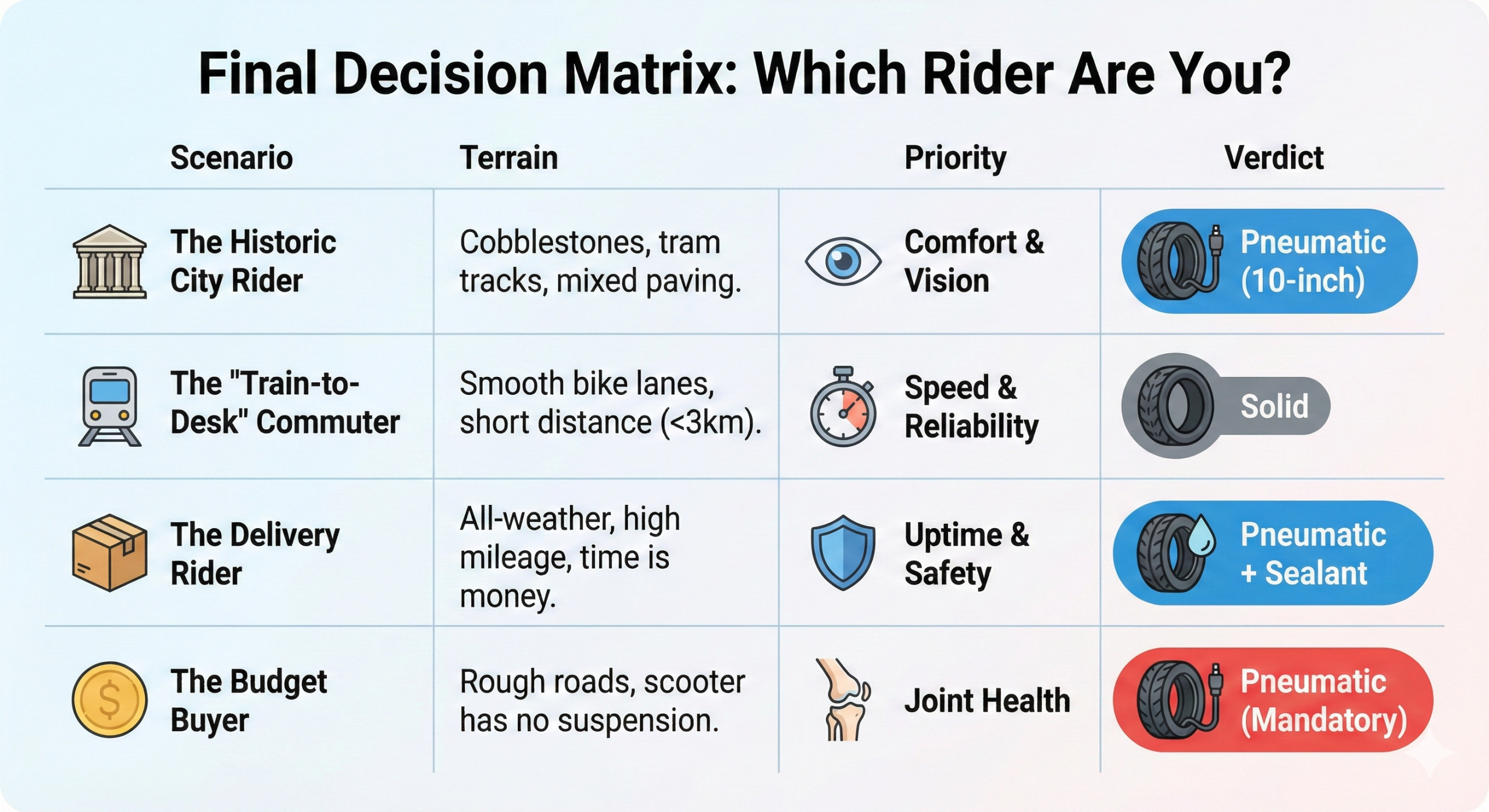
Final Decision Matrix: Which Rider Are You?
Conclusion
Your tires are your scooter’s shoes. You can wear hiking boots (Pneumatic) or wooden clogs (Solid). Both protect your feet, but only one lets you walk all day without pain.
If your commute is smooth and short, the convenience of solid tires is unbeatable. But for the reality of most European cities—with their beautiful but uneven streets and unpredictable weather—pneumatic tires remain the superior choice for safety and comfort. The occasional flat tire is a small price to pay for a ride that doesn’t rattle your bones.
Next Step: Tomorrow morning, look down at your route. Really look at the asphalt texture. Ask yourself: “Could I handle feeling every single inch of this in my wrists?”
