- Shipping Company Estimated Delivery Time Shipping Cost
Trusted Shipping Partners:  and more




Highlights
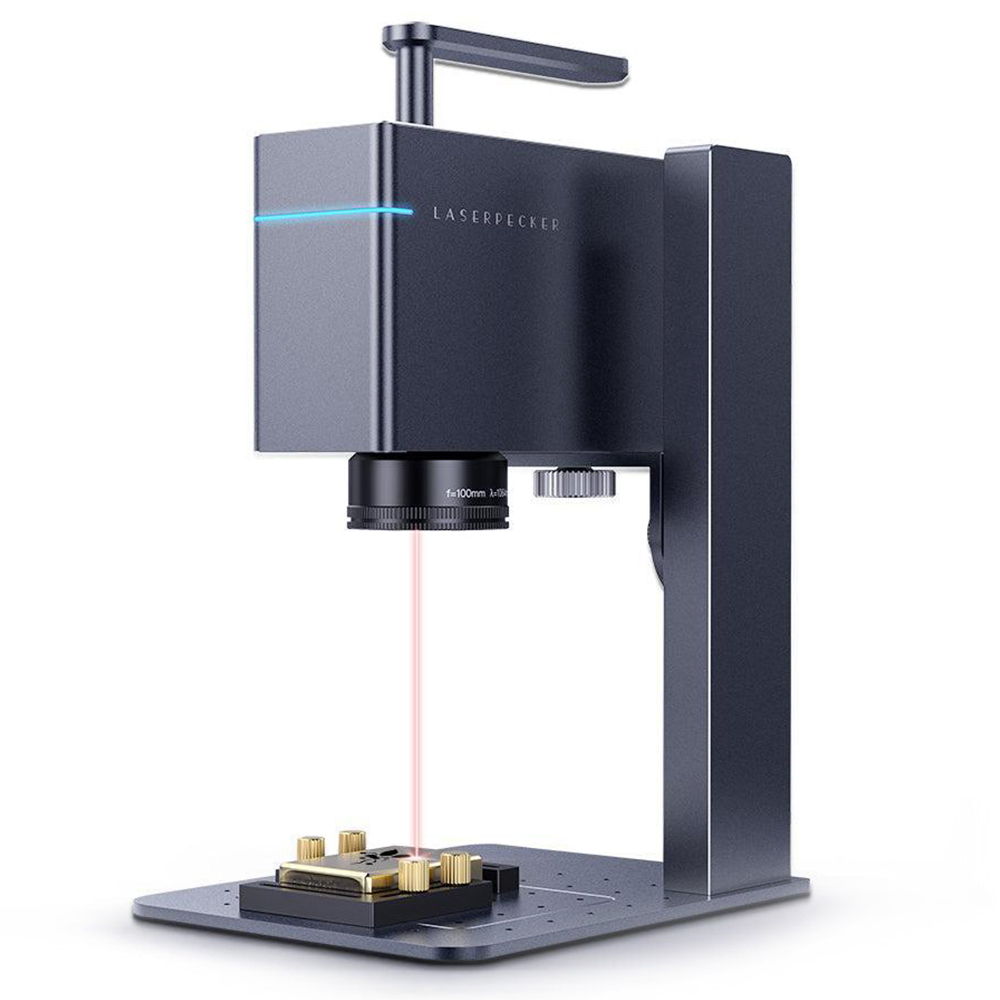
LaserPecker 3: The World's Smallest Pulsed Fiber Laser
LaserPecker 3 is a laser engraver that operates at a wavelength of 1064nm and is specifically designed for engraving on metal and plastic. It allows for easy DIY and customized engraving. In addition, it has more advantages over the blue laser variants in terms of engraving speed, it has reached 600mm/s.
- Metal & Plastic Engraver
- 4k Ultra-High Precision
- 800mm/s High Speed
- Dual Red-Light Focus
- Batch Engraving
Unlike the second generation, the LaserPecker 3 delivers outstanding performance when engraving on metal and plastic surfaces. The device is claimed to be the smallest portable fiber optic marking machine available.
With dual optical lenses and dual focus, the machine achieves high-precision engraving with 4K resolution. We can hand-hold it to engrave directly on the surface of an object, regardless of its size and shape. A dual roller auto-rotation kit (which has to be bought separately) is also available to achieve 360° rotation engraving on the cylinder.
Upgraded LaserPecker 3
LaserPecker 3 adds powerful features along with an easy-to-use interface to make laser engraving affordable and simple for beginners, hobbyists, and professionals alike. The sleek, compact, plug-and-play device sets up in seconds and works with a smartphone to transfer images and begin engraving with just a few clicks.
Long Life Portable Power Supply
With a 6400mAh capacity, this laser engraver supply provides 4 hours of continuous engraving time when fully charged.
360 Degree Cylindrical Rotating Engraving
LaserPecker 3 is capable of 360-degree rotating engravings on cylindrical objects, as well as curved or uneven surfaces. (The accessory should be purchased separately)
Fixed Material Jig
Comes with an adjustable material figure, and it can fix objects to the base of the unit and make multiple engravings fast and efficiently.
600mm/s Engraving Speed & 5000mm/s Preview Speed
With integrated design and high-speed vibration technology, 600mm/s engraving speed can be realized. Compared to the LaserPecker Pro first generation, it's a giant leap forward. It features a super-fast preview speed of 5000mm/s, and the industrial-grade fully digital Galvo scanning system fully supports square and graphical previews, making the positioning much easier, more accurate, and intuitive.
Clear HD 4K Resolution
Laser accuracy is doubled with a new optimized algorithm. Three engraving resolution options of 1k, 2k, and 4k provide the level of the perfect detail at your fingertips.
Dual Red-Light Focusing for Accurate Automatic Ranging
You can use the LaserPecker App to control the machine stand up and down, and the dual red lights overlapping focusing adjust to objects with different heights for fast and accurate engravings.
0.01MM High-Precision with Field Mirror Focusing Technology
The compressed spot has higher power, higher engraving ability, faster speed, and better effect under the same electric power.


Specification
| General |
Brand: LaserPecker |
| Specification | Average Power: 1000mw Max Power: 10000mw Laser Wavelength: 1064nm Laser Source: II-VI Laser EnterpriseErlu optics Engraving Area: ellipse: 90x80mm, square: 60x60mm Resolution: 1k, 2k, 4k Preview Mode: Square Preview + Graphical Preview Preview Speed: 5000mm/s Engraving Speed: 6mm/s - 600mm/s Wireless Connection: Bluetooth 5.0+ Supported File Formats: JPG, SVG, PNG, BMP, G Code, CAD, Al, CDR, DWG, and more Support System: Phone: Android & iOS, PC: Windows & Mac OS Output: 12V 5A, 220-240V, 50-60Hz |
| Weight & Size | Product Weight: 2.54kg Package Weight: 3kg Product Size(L x W x H): 19.4X15.35X26.11cm Package Size(L x W x H): 29.5x29x18.6cm |
| Package Contents |
1 x LaserPecker 3 Laser Engraver |
Videos
Customer Photos

Customer Videos
Customer Reviews
Questions & Answers
FAQ
Q1: What is the power of LaserPecker 3?
A: LaserPecker 3 is a 1w, 1064nm pulse fiber engraving machine (its peak power can reach 10kw).
Q2: What is the focal of LaserPecker 3?
A: LaserPecker 3's focal length is 11.2cm to 11.5cm.
Q3: What materials can LaserPecker 3 engrave on?
A: LaserPecker 3 can engrave on almost all pure metals and alloys, like gold, silver, copper, aluminum, iron, titanium, stainless steel, and plastics like AEV, PET, acrylic, PH, and PVC without pretreatment. Besides, LaserPecker 3 can engrave on artificial leather, lacquered paper, lacquered wood, parts of stones, purple clay, etc.
Q4: What safety certifications does LaserPecker 3 have?
A: LaserPecker 3 has IEC60825-1, CE-RED, ROHS, FCC, FDA, NC, and CDRH Registered certification.
Q5: What is the difference between LaserPecker 3 and LaserPecker 2?
A: LaserPecker 2 and LaserPecker 3 are two totally different lasers-LaserPecker 2 is a diode laser, while LaserPecker 3 is a fiber laser. LaserPecker 2 can engrave on almost all common materials, but a pretreatment is needed before engraving on metal and plastics. While LaserPecker 3 is made for engraving on metals and plastics, it can achieve great results on them without pretreatment.
Q6: What is the engraving area of LaserPecker 3?
A: LaserPecker 3's ordinary engraving area is 60mm*60mm, max engraving area is 90mm*80mm.
Q7: How fast can LaserPecker 3 engrave?
A: LaserPecker 3 can engrave at the speed of 6mm/s-600mm/s.
Q8: What accessories can the LaserPecker 3 work with?
A: Accessories for LP3 are fixtures, goggles, Bluetooth dongle, and versatile electric roller.
Q9: Differences Between LaserPecker 2 and LaserPecker 3?
LaserPecker offers relatively few models, but its high price range may make many potential buyers hesitant when deciding to invest in one. After all, buying can be a big commitment, and it can be hard to change course once a choice is made.
Even when buyers consider adding a few hundred dollars to their budget, it can be challenging to determine whether the extra cost is ultimately worth it. As a result, there have been many discussions on the site about which laser engravers offer the best value in two of our most popular products, the LP2 and LP3, and whether they are worth buying.
Let me briefly introduce the main features of these two models. The LaserPecker 2 uses diode laser technology utilizing the latest compressed spot technology with a wavelength of 450nm. It's great for engraving on wood, leather, and some types of metal, but bare metal requires additional prep. To turn a diode laser into a stainless steel engraver, you need laser bond spraying. Simply spray on the adhesive marker and engrave as usual.
The LaserPecker 3, on the other hand, uses infrared laser technology with a wavelength of 1064nm and is designed for metal, plastic, and leather engraving. If metal or plastic engraving meets most of your needs, then we wholeheartedly recommend the LP3 model.
To assist in this decision-making process, we would like to highlight the main differences between the two machines in terms of parameters and applicable materials. By reviewing these distinctions, we hope customers will be able to make an informed choice that meets their needs.
| LaserPecker 2 (Basic) | LaserPecker 3 (Basic) | |
|
Applicable materials |
A broad range of materials that include painted metal, anodized metal, 304 stainless steel, bamboo, wood, leather, food, paper, cloth, photosensitive stamp, plastic, acrylic, colored glass, glazed ceramics, and more |
Metal, plastic, and leather |
|
Power |
5w |
1w |
|
Laser Type |
Diode laser |
Infrared laser |
|
Engraving size |
Common: 100*100mm |
Ellipse: 115mm*80mm Square: 65mm*65mm |
|
Focal length |
110mm |
130mm |
|
Accuracy |
0.05mm (2k resolution) |
0.005mm (4k resolution) |
|
Depth |
0.5mm |
0.05mm |
|
Laser spot |
0.05mm |
0.03mm |
|
Modes available |
Cylinder mode, Slab mode, and Trolley mode |
Only Cylinder mode |
|
Special requirement (pretreatment) |
Pretreatment required for metal and plastics |
Not required
|