- Shipping Company Estimated Delivery Time Shipping Cost
Trusted Shipping Partners:  and more


Product Summary
The Elegoo Centauri Carbon 2 Combo is an enclosed CoreXY FDM 3D printer for makers and advanced hobbyists who want faster output plus simple 4-color printing in a single desktop machine. It provides a 256 × 256 × 256 mm build volume, uses a manufacturer-listed hotend rated up to 350°C, and pairs it with a heated bed rated up to 110°C for common filaments and select higher-temperature materials. The Centauri Carbon 2 Combo clearly positions itself as an upper mid-range prosumer option by combining an enclosed CoreXY platform with multicolor capability and high-temperature hardware at this build size.
Key Facts Table
| Attribute | Details |
|---|---|
| Product Name | Elegoo Centauri Carbon 2 Combo 3D Printer |
| Printing Speed | ≤ 500 mm/s (Recommended: 250 mm/s) |
| Printing Accuracy | ± 0.1 mm |
| Maximum Acceleration | 20,000 mm/s² (Default: 20,000 mm/s²) |
| Build Volume | 256 × 256 × 256 mm |
| Layer Thickness | 0.1–0.4 mm (Recommended: 0.2 mm) |
| Max. Nozzle Temperature | 350 °C |
| Camera | Yes (AI Intelligent Detection & Timelapse) |
- The CoreXY motion system supports manufacturer-listed print speeds of up to 500 mm/s, while a recommended 250 mm/s setting helps balance speed and print stability.
- A stated printing accuracy of 0.1 mm helps the printer hold consistent external dimensions for general-purpose prototypes and fit-check parts.
- Maximum acceleration is listed at up to 20,000 mm/s², which helps reduce travel time on short moves when the model contains many small features.
- The 256 × 256 × 256 mm build volume provides a cubic print space suitable for many mid-size functional parts, enclosures, and multi-part assemblies.
- Layer thickness support from 0.1 to 0.4 mm lets users trade surface detail for throughput, and a recommended 0.2 mm layer height targets a practical balance for everyday printing.
- The 350 °C maximum nozzle temperature supports higher-temperature materials and helps maintain stable extrusion when printing heat-resistant filaments.
- The integrated camera enables live monitoring and time-lapse recording, so you can track print progress remotely and review prints afterward. AI intelligent detection through the onboard camera helps flag potential print issues early, reducing the chance of failed prints going unnoticed.
Highlights
CoreXY High-Speed Precision Motion
The Elegoo Centauri Carbon 2 Combo uses a CoreXY motion structure to support fast toolhead movement while maintaining controlled, repeatable positioning. In rapid prototyping and functional fit-check workflows, this CoreXY setup helps reduce visible artifacts caused by vibration so you can validate dimensions and assembly intent sooner without reprinting for motion-related defects.
4-Colour Printing for Multi-Material Visuals
This Elegoo Centauri Carbon 2 Combo 3D printer supports 4-colour printing, enabling multi-colour models in one job rather than stopping for manual filament changes. For creators producing labelled prototypes, presentation parts, or character models, four-colour output helps you communicate design intent more clearly while keeping the workflow consistent from print start to print completion.
High-Speed Output for Faster Iteration
The Centauri Carbon 2 Combo is specified for up to 500 mm/s printing speed, targeting shorter time-to-part when you need multiple iterations in a limited window. In practical use, this lets you move from CAD change to physical test print faster, which is especially useful for small jigs, brackets, and quick validation prints that would otherwise block the next design step.
High-Temperature Nozzle and Heated Bed Control
Engineered for material flexibility, the Elegoo Centauri Carbon 2 Combo includes a 350 °C hardened steel nozzle and a heated bed to stabilise first-layer adhesion and reduce warping risk on more demanding filaments. When you are printing functional parts that need higher heat resistance, this temperature capability helps maintain extrusion consistency and layer bonding without forcing you to downshift into easier but less suitable materials.
Automatic (Partial) Bed Levelling and Live Monitoring Camera
To reduce setup friction, the Elegoo Centauri Carbon 2 Combo provides auto leveling with partial bed-leveling so the machine focuses calibration where the model will actually be printed. With the built-in camera offering live monitoring and timelapse, you can verify first-layer success remotely and catch issues early, which is valuable for long runs or multi-colour jobs where restarting wastes more time and filament.
Reliability Safeguards for Unattended Printing
The Centauri Carbon 2 Combo is positioned for longer, less supervised print sessions by combining automation features with a monitoring-ready workflow via the onboard camera. For users who run prints overnight or while working, this reduces the need for constant check-ins and supports a more predictable production rhythm for prototypes and small-batch parts.
ELEGOO CANVAS
Innovative multi-color technology, redefining the new realm of 3D printing!

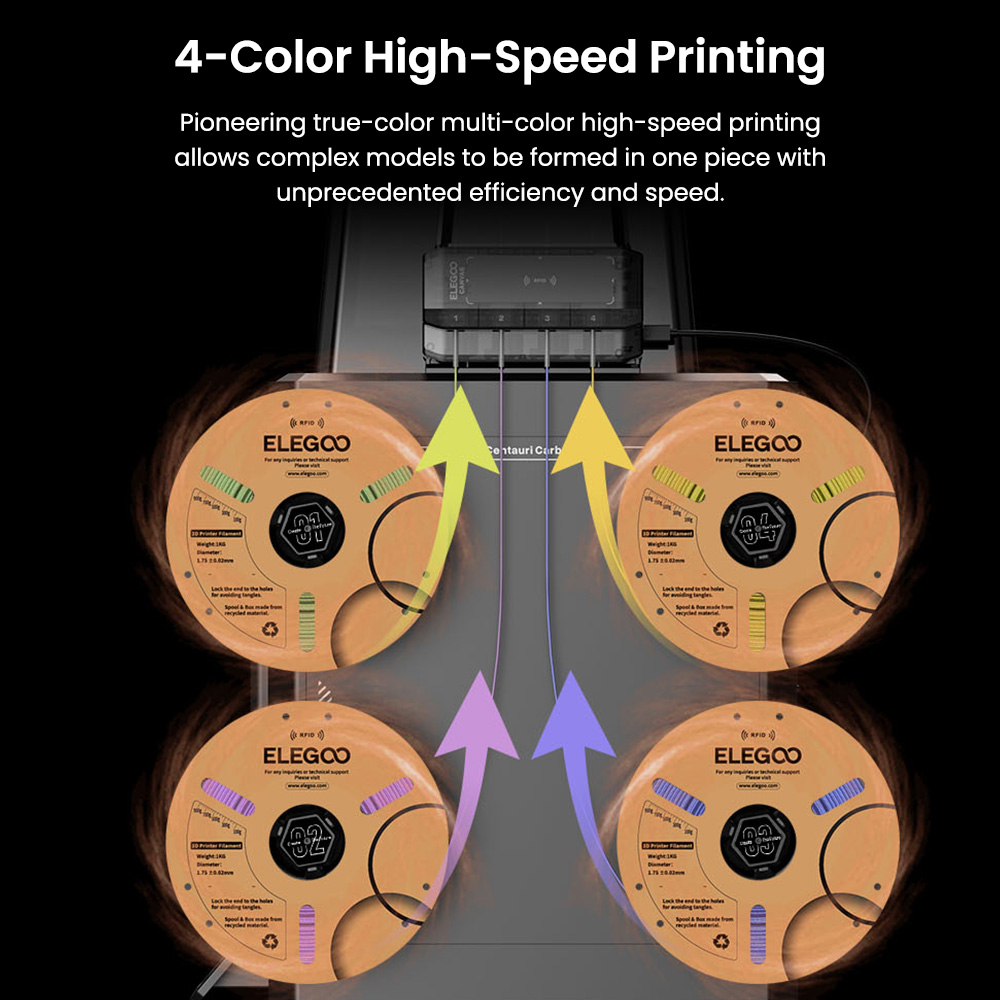
4-color High-Speed Printing
Pioneering true-color multi-color high-speed printing allows complex models to be formed in one piece with unprecedented efficiency and speed.

Automatic Filament Refilling
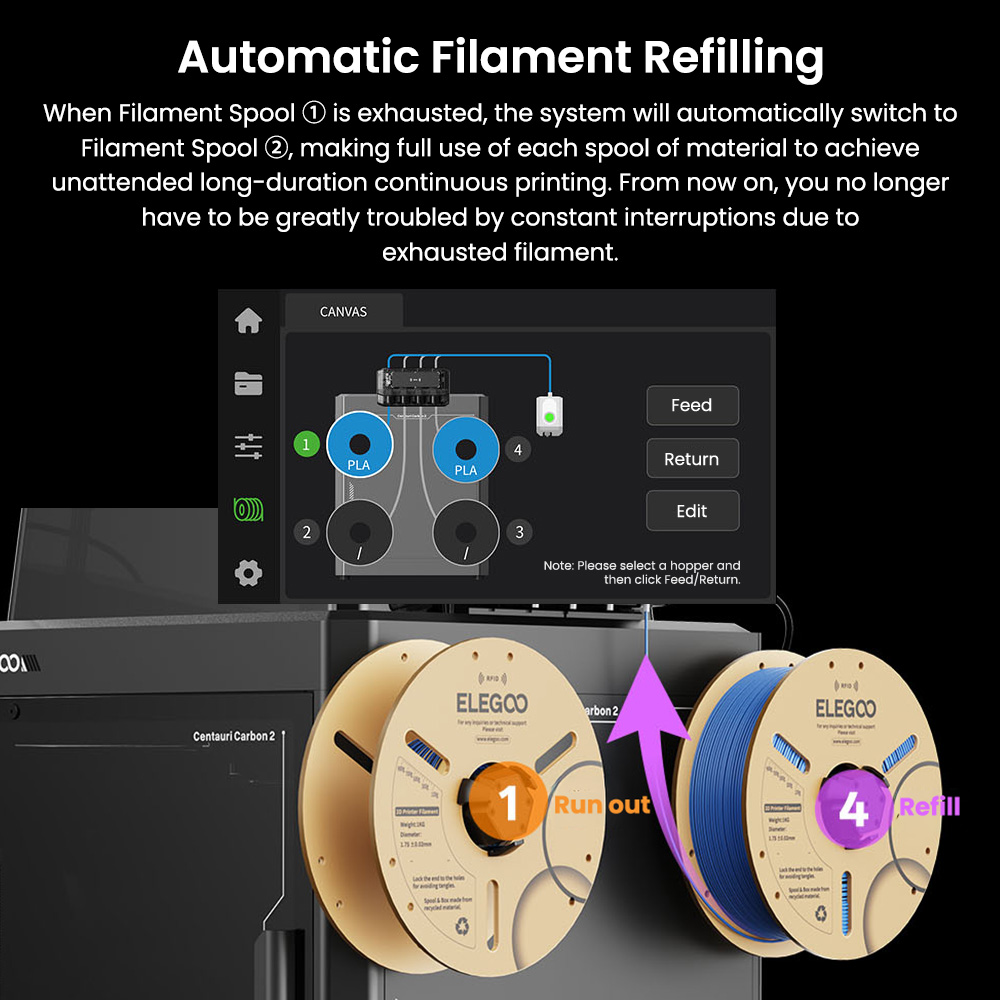
When Filament Spool ① is exhausted, the system will automatically switch to Filament Spool ②, making full use of each spool of material to achieve unattended long-duration continuous printing. From now on, you no longer have to be greatly troubled by constant interruptions due to exhausted filament.
RFID Filament Identification
Equipped with an intelligent RFID reader, simply place the filament spool in position and CANVAS will identify the filament's color, type, and more information. It automatically recognizes and matches parameters, taking the printing experience to the next level.

Rotary Filament Storage Rack
Orderly in and out, never messy. The intelligent recycling function can precisely control the filament retraction amount, fundamentally eliminating the risk of filament tangling and hanging. It also supports compatibility design, allowing you to freely choose most brands of filaments on the market.

RFID Paper Tray | ELEGOO Tray | Paper Tray | Transparent Tray

Enclosed Printing
Custom-made for Centaur Carbon 2 + CANVAS, it provides quiet isolation and an outstanding appearance, keeping it spotless. The semi-open design facilitates observation, allowing you to enjoy the cozy printing experience with Centaur Carbon 2 CANVAS.

Fast Filament Loading/Unloading
CANVAS supports a filament loading/unloading speed of 500 mm/s and an acceleration of 20000 mm/s². The color change efficiency is 15% higher than other multi-color products, greatly reducing the time consumption of multi-color printing—letting you have both efficiency and vibrant colors.
Color change time
Color change efficiency improved by 15%

Indicator Light
Each of the four material positions is equipped with an independent multi-color LED indicator: solid white (ready), white breathing light (printing), and red (abnormal). No need to open the app; you can instantly monitor the CANVAS operating status and have complete control.

Modular Assembly
Modular assembly, simple and aesthetic, letting you start an excellent printing experience right away.


Pros & Considerations
Pros
- A 256 × 256 × 256 mm build volume supports larger models or batch printing of multiple parts in a single job for improved productivity.
- Multicolor printing enables decorative accents, color separation, and visual labeling without manual filament changes.
- Print speeds up to 500 mm/s (250 mm/s recommended) help accelerate prototyping and shorten iteration cycles.
- With a maximum nozzle temperature of 350 °C, the printer supports a wider range of advanced and engineering-grade filaments than standard hotends.
- Dual-gear direct drive extrusion delivers stable, precise filament feeding, especially for TPU and retraction-sensitive materials.
- A dual-sided textured PEI spring steel build plate provides strong adhesion and easy model removal after printing.
- 121-point auto bed leveling and fully automatic calibration streamline setup and improve printing consistency.
- Built-in AI camera monitoring with timelapse supports remote supervision and helps detect common print issues during long jobs.
- Wi-Fi and USB connectivity provide flexible printer placement and convenient file transfer for different workspace setups.
Considerations
- The multicolor printing workflow generates additional purge material during color transitions to ensure clean and accurate color separation throughout the print.
- The high-speed motion system is optimized for rapid prototyping and fast production, which may require additional tuning to achieve the highest possible surface finish quality on detailed models.
- The 350 °C hotend capability prioritizes broader filament compatibility, which means you may need stronger ventilation and more temperature-controlled setup practices when printing higher-emission engineering materials.
FAQ
I mainly want to print colored figurines and models. Can it really print four colors at once? Do I need to buy any additional accessories?
No additional accessories are needed. It supports four-color printing, allowing you to combine multiple colors/materials in a single print job.
I’m printing prototypes on deadlines, can I actually use the 500 mm/s speed day to day, or will quality tank?
This machine is designed for high‑speed + precision printing: it uses a CoreXY structure to reduce vibration during fast movement, and it lists up to 500 mm/s toolhead speed and 20,000 mm/s² acceleration. Real usable speed depends on model detail, material, and slicer settings, but the hardware is clearly built for fast turnaround prototyping.
I need ABS/ASA/PC for functional parts. Are the temperatures high enough, or will it struggle?
The hotend is rated up to 350 °C and the heated bed up to 110 °C, and it explicitly supports ABS, ASA, and PC. It also supports PLA, PETG, TPU, and composites like PLA‑CF / PET‑CF, so it’s meant to cover a wide range of materials.
I print TPU fairly often. Will it handle flexible filament for things like phone cases or dampers?
TPU is supported, so it’s suitable for flexible parts like protective covers, vibration isolators, and soft functional components. TPU is more sensitive to feed/retraction and speed than PLA, so start with conservative TPU settings and tune from there.
Will printing carbon‑fiber composites (PLA‑CF / PET‑CF) wear the nozzle quickly? Does it come with a wear‑resistant nozzle?
It supports PLA‑CF / PET‑CF composite printing. Composite filaments are typically abrasive, so a wear‑resistant nozzle is generally recommended for frequent use. If you plan heavy CF printing, confirm the included nozzle configuration and keep spare nozzles on hand.
I’m printing at home. How bad are fumes/particles, and what filtration does it use?
It includes a multi‑fan cooling system plus filtration using coconut‑shell activated carbon + a HEPA air filter, intended to improve the printing air‑quality experience.
I’m a beginner and don’t want to constantly re-level. Does it do auto bed leveling, and how?
Yes. It supports fully automatic bed leveling using pressure sensors, designed to reduce manual maintenance and improve first‑layer consistency.
Can I remotely monitor prints? Does it have a camera?
It has a built‑in camera for remote monitoring, so you can check progress when you’re not next to the printer.
If there’s a power outage or overheating risk, will it protect my print?
It includes power‑failure recovery and overheat protection, which helps reduce risk during long or unattended prints.
Final Overview
| Basic Specs | Details |
| Type | 3D Printer |
| Model | Centauri Carbon 2 Combo |
| Color | Black |
| Multicolor Capability | Yes |
| Supported Filament | Ideal: PLA/PETG/TPU/ABS/ASA/PLA-CF; Capable: PETG-CF/ABS-CF/ASA-CF/PET-CF/PA-CF/PET/PC/PA |
| Filament Diameter | 1.75 mm |
| Technology | Fused Deposition Modeling (FDM) |
| Printing Platform Size | 260 × 260 mm |
| Extruder | Dual-Gear Direct Extruder (1 Fan) |
| Nozzle | Brass-Hardened Steel |
| Nozzle Diameter | 0.4 mm |
| Build Plate | Dual-Sided Spring Steel Sheet (Textured PEI + PLA-Specific Surfaces) |
| Bed Leveling Method | 121-Point Auto-Leveling |
| Heat Break | Titanium Alloy |
| Z-Axis Lead Screw | 3 Lead Screws, 3 Linear Guide Rods |
| Motor Drive | Silent Drive (All Axes) |
| Motherboard | Powerful Self-Developed Motherboard |
| LED Lighting | Yes |
| Max. Heated Bed Temperature | 110 °C (Ambient Temperature 25 °C) |
| Ambient Temperature | 5–40 °C |
| Filament Run Out Sensor | Yes |
| Clog Detection | Yes |
| Power Loss Recovery | Yes |
| Full-Auto Calibration | Yes |
| Auto Filament Unloading | Yes |
| System | ELEGOO OS |
| Touch Screen | 5-inch Color Capacitive Touch Screen |
| Language | English, French, German, Russian, Italian, Spanish, Japanese, Chinese |
| Connectivity | USB, Wi-Fi |
| Slicing Software | ElegooSlicer (Recommended), Orca, Cura |
| Input Format | STL, OBJ, 3MF, STEP |
| Output Format | Gcode |
| Power Input | 100–240 VAC; 50/60 Hz |
| Power Output | 24 V |
| Rated Power | 1100 W @ 220 V; 350 W @ 110 V |
| Operating Sound | ≤ 45 dB |
| Weight & Size | Details |
| Product Weight | 19.35kg |
| Package Weight | 24.2kg |
| Product Size | 500×480×743 mm |
| Package Size | 490×495×560mm |
| Package Contents | Details |
| 1 x | Touchscreen |
| 1 x | Nozzle Wiper Assembly |
| 1 x | Power Cord |
| 1 x | 4-Pin Cable |
| 4 x | Spool Holder Module (2 Left, 2 Right) |
| 1 x | Filament Hub |
| 1 x | CANVAS Mounting Bracket |
| 1 x | Thermal Cover |
| 1 x | User Manual |
| 1 x | Unclogging Pin |
| 4 x | Allen Key (1.5/2.0/2.5/3.0 mm) |
| 1 x | Screwdriver |
| 1 x | Filament Sample |
| 1 x | Spare Nozzle Wiper |
| 1 x | USB Drive |
| 1 x | Scraper Blade |
| 4 x | PTFE Tube |
| 4 x | PM3x6 — Filament Hub& Nozzle Wiper Assembly |
| 2 x | PA3x10 — Scraper Blade |
| 3 x | PM3x8 — CANVAS Feeding Module |
| 8 x | HM3x14 — Spool Holder |
| 2 x | PM3x50 — CANVAS Mounting Bracket |
| 2 x | FM3x12 — Nozzle Wiper Assembly |
Bottom Summary
ELEGOO Centauri Carbon 2 Combo is best suited to makers, educators, and small businesses that want fast iteration plus clean multicolor presentation from a single CoreXY machine, without stepping up to industrial pricing. Its value lies in turning design-to-print cycles into predictable outcomes—quick prototypes, small-batch functional parts, and color-coded assemblies—while staying flexible across everyday and tougher engineering filaments. Practical touches like automatic leveling, remote monitoring, filtration, and print-recovery features reduce babysitting during long runs and shared-shop use. It remains a suitable choice for users looking for high-speed precision and multicolor versatility who are willing to accommodate a larger desktop footprint and the extra workflow overhead of multi-material printing.
Videos